
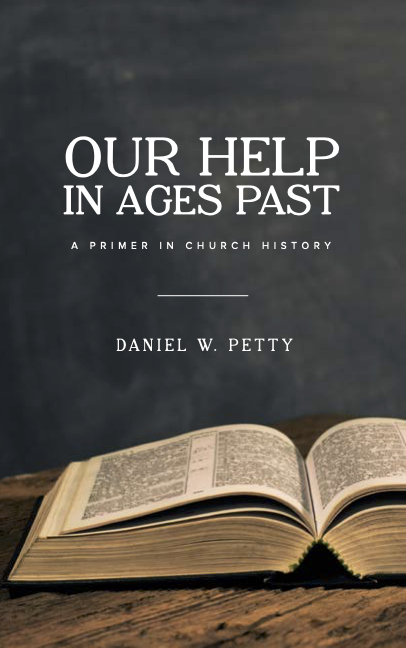
Our Help in Ages Past: A Primer in Church History
Foreword by Dr. C. G. “Colly” Caldwell
Published by Florida College Press (2024)
Available at FC Bookstore
Click link to order:
https://bookstore.floridacollege.edu/product/64216/Our-Help-in-Ages-Past/
Chapters
- Introduction
- The New Testament Church
- Christians in a Hostile World
- The Church Confronts Heresy
- Doctrinal Controversies in the Early Church
- The Emergence of Catholicism and the Middle Ages
- Luther and the Protestant Reformation
- The Spread of Protestantism and Reform Movements
- The Reformation and the Story of the English Bible
- Anabaptists: Sixteenth-Century Restorationists
- Denominational Growth and Religious Renewals
- Modern Challenges to Faith
- The Restoration of the Ancient Order
From the Preface
The title of this book, Our Help in Ages Past, is borrowed and adapted from the title of a great hymn. Isaac Watts (1674–1748) is one of the more well-known names in the history of hymn writing. Watts, a minister among the English nonconformist Congregational churches, wrote some 750 hymns, many of which continue to be used in churches today. “O God, Our Help in Ages Past,” written in about 1708, begins with this opening stanza:
O God, our help in ages past,
Our hope for years to come,
Our shelter from the stormy blast,
And our eternal home.
Watts wrote the hymn as a paraphrase of Psalm 90, a psalm attributed to Moses, the man of God. Psalm 90 consists of a humble meditation on the frailty of man and the brevity of life, which stand in sharp contrast to the eternal, sovereign rule of God over the affairs of man in time and history. It is a reminder that God has been “our dwelling place in all generations.” But it also is an acknowledgement that the days of men are marked by failure as often as faithfulness. So, the psalmist prays that God will “Teach us to number our days that we may get a heart of wisdom… Let your work be shown to your servants, and your glorious power to their children. Let the favor of the Lord our God be upon us, and establish the work of our hands upon us; yes, establish the work of our hands!”
The sentiments of Psalm 90—and the beautiful hymn it inspired—recall God’s everlasting sovereignty in history, and remind us of lessons history can teach us. Only through God and his word are any of man’s accomplishments for good established, and in his lovingkindness, he ever calls us back to himself when we stray.
The idea for this book grew out of my thirty years of teaching courses in church history at the college level, as well as several opportunities to present a series of lessons on the subject in local churches of Christ around the country.
This work is intended to serve as a short introduction—a “primer” in the study of church history. It presents a brief survey of the sweep of church history, or the history of Christianity, since its beginnings in New Testament times to the present. It is a very small book for such a big subject, so much selectivity went into its writing. Historians must of necessity omit a great deal of information as they select that which is most relevant and helpful in telling the story. That is especially true in such a short survey as this. This survey focuses on key people, movements, events, and ideas that were pivotal in the story, while endeavoring to help the reader get a sense of the general historical context in which they occurred.
At the same time, the common theme that I have followed through every chapter is the principle that the divine plan for human redemption and pattern for the church have been revealed in Scripture. As a restorationist, I believe the primitive church was intended to be normative, and that the New Testament sets forth an apostolic pattern for the church. History can help us see the degree to which men and movements throughout history have adhered to that pattern, or moved away from it. History also records the story of people who committed themselves courageously to the work of renewal, reform, and restoration in the church when they recognized the need. I have included material that focuses on the primacy of Scripture—including the recognition of the New Testament canon and the story of the English Bible—as well as examples of those who sought to return to its message and to the primitive order.
I have sought to provide a book suitable for individual reading, small group studies, or classes in church history in local congregational settings. Each chapter is followed by suggestions for further reading and study, as well as questions for reflection and discussion, especially focusing on practical lessons and scriptural applications. If this small volume helps someone to have a better perspective of the past and a greater appreciation of our spiritual heritage, it will have served its purpose.

 Lamp Posts
Leave a comment