
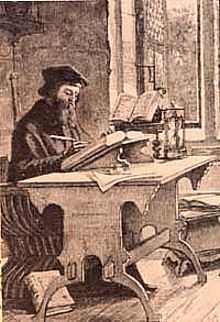
An important forerunner of the Protestant Reformation was John Wycliffe (ca. 1324–1384), an eminent Oxford professor. Wycliffe lived during the so-called “Babylonian Captivity of the Church” (1309–1378), when the papal headquarters were in Avignon, France; and the “Great Schism” when there were rival popes at both Rome and Avignon (1378–1417). These issues and other clerical abuses damaged the prestige of the church and contributed to increasing calls for church reform.
Wycliffe began to study the whole question of the nature of the church, and spoke out on the authority of Scripture and the need for New Testament precedent. In his teaching he insisted that Christ was the head of the church. He promoted the study of Scripture over church Tradition. He asserted the Bible was the sole authority for believers instead of the church, and that the church should be based on the pattern of the New Testament. He appealed to the Scriptures as the final authority in faith and morals, including church practice and organization.
He believed every man was directly responsible to obey God’s law as revealed in the Bible. It followed that every man must know the Bible, so the whole Bible should be made accessible to Christians in a form they could read and understand. He believed the answer was for people to be able to read the Bible for themselves in their native English.
It is uncertain how much of the work of Wycliffe’s translation was the work of Wycliffe himself, and how much was that of his associates. But there is little doubt he played a leading role, and the translation was produced between 1380 and 1384. Wycliffe’s version was not translated from the original Hebrew or Greek, but rather was an English rendering of the Latin Vulgate. When Wycliffe died in 1384, he left behind several committed disciples. His secretary, John Purvey, produced a revision of the Wycliffe Bible in the English idiom of the day, making it more appealing than a word-for-word rendering of the Vulgate.
Wycliffe influenced others of his time, including his younger contemporary John Huss of Bohemia (1369–1415). Huss followed the teachings of Wycliffe, emphasizing the authority of the Bible and calling for moral reform. Huss was burned at the stake for heresy by order of the Council of Constance in 1415. Wycliffe himself was posthumously declared a heretic by the same council. His writings were banned and ordered to be burned. In 1428, Wycliffe’s remains were exhumed and burned, the ashes scattered in the River Swift.
Despite these measures, Wycliffe’s teachings were carried forward by his followers. These traveling preachers, nicknamed “the Lollards,” went about preaching in English and circulating English Bibles. There were still Lollards in England at the time of the Protestant Reformation. The Wycliffe Bible continued to enjoy wide circulation.
Wycliffe was in many ways a pioneer—in his efforts to bring about needed reform as well as his ground-breaking work in Bible translation. Because of his work, which in many ways anticipated the reformers of the sixteenth century, Wycliffe has been called “The Morning Star of the Reformation.”

 Lamp Posts
Leave a comment